Students on the RPE202 Buddhism module may find the podcasts at http://amberstar.libsyn.com/ of interest..
Or maybe some Zen Radio at http://www.wzen.org/
Enjoy...
Dave
Wednesday, May 02, 2007


Thursday, April 19, 2007
New Course Map
Hi - long time, no posts...
Well, the sun has been out, and it has been the holidays.
Anyway, back to it as we are, I thought I would update students (and other interested parties) with regard to changes to the Field (Course) map for next year...
New modules:
RPE108 Greek Philosophy
OTC116, Rome Field Trip (now counts as an RPE module)
RPE209 Philosophy of Mind
RPE208 Religions of India (double module, replacing the Hinduism and Buddhism modules)
RPE307 Close Philosophical Reading
Changes:
RPE301 Love, Sex and Death and RPE304 Ethics and Reason are both to become 'double' modules...
There are other minor changes, linked to changes in the shape of the academic year, but these are the main ones...
Cheers, Dave
[Field Chair, Religion, Philosophy & Ethics]
Well, the sun has been out, and it has been the holidays.
Anyway, back to it as we are, I thought I would update students (and other interested parties) with regard to changes to the Field (Course) map for next year...
New modules:
RPE108 Greek Philosophy
OTC116, Rome Field Trip (now counts as an RPE module)
RPE209 Philosophy of Mind
RPE208 Religions of India (double module, replacing the Hinduism and Buddhism modules)
RPE307 Close Philosophical Reading
Changes:
RPE301 Love, Sex and Death and RPE304 Ethics and Reason are both to become 'double' modules...
There are other minor changes, linked to changes in the shape of the academic year, but these are the main ones...

Cheers, Dave
[Field Chair, Religion, Philosophy & Ethics]
Tuesday, April 03, 2007
Buddhism, Philosophy as therapy - some thoughts..
Some thoughts over Easter: I know many students are away for the break – perhaps you may have more time than normal to think? so some thoughts....
Many of you are doing the Buddhism modules (RPE202), and there also seems to be a ‘craze’ for seeing philosophy as, in some sense, therapeutic (see http://www.geocities.com/Athens/Forum/5914/) . I was thinking of these two things in tandem this afternoon, and it struck me that we have been discussing themes pertinent here in class.
These have come out of our discussion as to whether Buddhism (esp in its early phase) counts as a religion. Well – I welcome comments on that topic – but also: can philosophy count as therapy?
Buddhism seems to count as therapeutic: –it includes the philosophy and a particular targeted practice (though we might, of course, dispute the accuracy pf the former and the efficacy of the latter).
Indeed Buddhism is if anything more sceptical of a certain philosophical ‘view holding’ (though after the very early phase scholasticism becomes a key part of Buddhist tradition), as we see in the Sisupacala Sutta, (trans from http://www.accesstoinsight.org/tipitaka/sn/sn05/sn05.008.than.html, SN 5.8):
Can Western philosophical traditions be considered as in any sense therapeutic without this kind of holistic approach?
Further, can Buddhism really be said to reject ‘views’ – and still propagate a position on as
many issues as it seems to?
Dave
Many of you are doing the Buddhism modules (RPE202), and there also seems to be a ‘craze’ for seeing philosophy as, in some sense, therapeutic (see http://www.geocities.com/Athens/Forum/5914/) . I was thinking of these two things in tandem this afternoon, and it struck me that we have been discussing themes pertinent here in class.
These have come out of our discussion as to whether Buddhism (esp in its early phase) counts as a religion. Well – I welcome comments on that topic – but also: can philosophy count as therapy?
Buddhism seems to count as therapeutic: –it includes the philosophy and a particular targeted practice (though we might, of course, dispute the accuracy pf the former and the efficacy of the latter).
Indeed Buddhism is if anything more sceptical of a certain philosophical ‘view holding’ (though after the very early phase scholasticism becomes a key part of Buddhist tradition), as we see in the Sisupacala Sutta, (trans from http://www.accesstoinsight.org/tipitaka/sn/sn05/sn05.008.than.html, SN 5.8):
Is the Nun here rejecting all views? We often get the view in Buddhism that the practice consists of the three elements found in the 8-fold path: wisdom (insight, maybe), morality (or virtue) and meditation practice.At Savatthi. Then, early in the morning, Sisupacala the nun put on her robes and, taking her bowl & outer robe, went into Savatthi for alms. When she had gone for alms in Savatthi and had returned from her alms round, after her meal she went to the Grove of the Blind to spend the day. Having gone deep into the Grove of the Blind, she sat down at the foot of a tree for the day's abiding.
Then Mara the Evil One, wanting to arouse fear, horripilation, & terror in her, wanting to make her fall from solitude, approached her & said, "Whose philosophy do you approve of, nun?"
"I don't approve of anyone's
philosophy, my friend."
[Mara:]
For whose sake
have you shaved your head?
You look like a contemplative
but don't approve
of a philosophy,
so why are you wandering here
confused?
[Sister Sisupacala:]
Outside philosophers place
their confidence in views.
I don't approve
of their teaching.
They're not adept in the
Dhamma.
But there is
the Awakened One,
born in the Sakyan clan,
a person without peer:
all-conquering,
Mara's subduer,
everywhere undefeated,
everywhere freed,
independent;
endowed with an
Eye all-seeing, reaching the end
of all kamma —
with the ending of
acquisitions, released.He, that Blessed
One, is my teacher.
It's in his Dhamma
that I delight.
Then Mara the Evil One — sad & dejected at realizing,
"Sisupacala the nun knows me" — vanished right there.
Can Western philosophical traditions be considered as in any sense therapeutic without this kind of holistic approach?
Further, can Buddhism really be said to reject ‘views’ – and still propagate a position on as
many issues as it seems to?
Dave
Thursday, March 29, 2007
New comment on The Ones Who Walk Away from Omelas
For more new comments on The Ones Who Walk Away from Omelas see http://r-p-e.blogspot.com/2007/03/ethics-in-ones-who-walk-away-from.html and scroll down - including a response by Ursula LeGuin herself, sent to Martha Allen Sherwood, in the context of discussions about the story...
Cheers - Dave
Cheers - Dave
Saturday, March 24, 2007
The runaway trolley and brain damage
For a video-podcast of me outlining the basics of the trolley problem see: http://philosvids.wordpress.com/2013/03/16/the-trolley-car-dilemma/
Some of you will have discussed in class the classic moral problem sometimes known as the runaway trolley case - where a trolley car is running out of control down a hill - and is about to kill 5 people, but you happen to be stood by a switch - with a lever: pull the lever and it switches trackes and the 5 people are safe.... but (there's always a 'but' in these examples) there is one person on the other track - do you pull the lever 'killing' 1 and 'saving' 5?
Now - you will recognise in this issues of Utilitarianism, and there are numerous variants that demonstrate some of the problems associated with assessing situations on the basis of utility... what if you knew some of the people - or if the 1 was a doctor, and the 5 were criminals on work-release - etc... Other variants include an example where there is no switch but you can push a man (in some version a fat man) in front [you are unable to put yourself in its path] and hereby save the 5 - is this different?
In surveys people are often reluctant to act when it involves an act which seems so directly like 'killing' - but I came across this interesting article in the New York Times which quotes a survey that seems to link answers to this variant version to areas of the brain - via a survey involving people with damage to certain parts of their brain. It is at: http://www.nytimes.com/2007/03/21/health/21cnd-brain.html?_r=2&hp&oref=slogin&oref=slogin
If we accept this - what does the link between brain areas and moral choice say about the nature of moral choice itself?
Dave
Tuesday, March 20, 2007
Buddhism podcast 4

Yes, here is the latest Buddhism (RPE202) podcast. This is on 'views' - and is limited by my being a bit full of cold - but hopefully still makes some kind of sense..
It follows up on the some of the discussions we have had in class regarding the way in which it might be not just the content of religious beliefs and ideas that matter in Buddhist thought, but also the manner in which the views are held...
Cheers,
Dave
Sunday, March 18, 2007
Horse Racing and Ethical Concerns
Well, as Cheltenham Festival (the racing one) comes to an end after the Gold Cup, I have spoke to a number of students who have had moral concerns about the status of horse racing - mostly jump racing...
Well- - I thought it was an intriguing topic for the blog..
The Animal Aid website at http://www.animalaid.org.uk/h/n/CAMPAIGNS/horse/ALL/// says:
And a campaign to ban the use of the whip says (see: http://www.livingethically.co.uk/Pages/HomeArticles/2007campaign-banthewhip.htm )
Is this convincing? Clearly the are issues about the instrumental use of animals, but for those who eat meat, wear leather and have pets - can we really criticse here without being hypocrites? What defence is offered by the industry? The Horseracing Regulatory Authority has guidance on the whip:
Well- - I thought it was an intriguing topic for the blog..
The Animal Aid website at http://www.animalaid.org.uk/h/n/CAMPAIGNS/horse/ALL/// says:
Most people regard horse racing as a harmless sport in which the animals are
willing participants who thoroughly enjoy the thrill. The truth is that, behind
the scenes, lies a story of immense suffering. Approximately 15,000
foals are born into the closely-related British and Irish racing industries
each year, yet only a third go on to become racers. Those horses who do not
make the grade may be slaughtered for meat or repeatedly change hands in a
downward spiral of neglect. Of those horses who do go on to race, around 375
are raced to death every year.
Beneath its glamorous façade, commercial horse racing is a ruthless industry motivated by financial gain and prestige. Cruelty? You can bet on it!
And a campaign to ban the use of the whip says (see: http://www.livingethically.co.uk/Pages/HomeArticles/2007campaign-banthewhip.htm )
Why should the whip be banned?
ITS USE IS TO PROMOTE UNNATURAL SPEED - The overiding reason for using a whip upon a racehorse is to get it to perfom at its absolute optimum - to encourge it to try harder or run faster than it would under natural conditions. This is of little benefit to the horse itself. Surely, to demand a horse runs at an artifically engineered speed through using a whip is done merely to satisfy human expectations and desires to see how fast horses will go in competition with each other.
A RACE IS STILL A RACE IF A WHIP IS USED OR NOT - The point of horse racing must be that they race against each other over a predetermined course and distance and the horse that passes the finishing post first wins. Whether a whip is used or not in this process is immaterial - without whips, a race could still be run and winners declared.
FOR SAFETY REASONS - Some horses veer or at least run away from a whip,
especially if inexperienced - this means that if for example a jockey is using
his whip in his right hand, the horse will move to the left. This can potentially cause accidents. Also, by running at an unatural speed - flat out - horses can make mistakes, especially when jumping.
WHAT WAS ACCEPTABLE THEN SHOULDN'T BE NOW - We do not use physical persuasions upon humans to control their behvaiour any longer, eg corporal punishment - why should horses be physically persuaded by the use of the whip to give unreasonably beyond their all? In different times, using a whip upon an animal was viewed as acceptable as it could be used on a human being, but this should no longer be the case.
Is this convincing? Clearly the are issues about the instrumental use of animals, but for those who eat meat, wear leather and have pets - can we really criticse here without being hypocrites? What defence is offered by the industry? The Horseracing Regulatory Authority has guidance on the whip:
The HRA will not tolerate abuse of the horse and consider its welfare, and the safety of the rider, to be paramount. The whip should be used for safety, correction and encouragement only and they therefore advise all riders to consider the following good ways of using the whip which are not exhaustive:
Showing the horse the whip and giving it time to respond before hitting it.
Using the whip in the backhand position for a reminder.
Having used the whip, giving the horse a chance to respond before using it again.
Keeping both hands on the reins when using the whip down the shoulder in the backhand position.
Using the whip in rhythm with the horse’s stride and close to its side.
Swinging the whip to keep a horse running straight.The HRA has asked Stewards of Meetings to consider holding an enquiry into any case where a rider has used his whip in such a way as to cause them concern and publish the following examples of uses of the whip which may be regarded as improper riding:
Hitting horses:to the extent of causing
injury;
with the whip arm above shoulder height;
rapidly without regard to their stride, i.e. twice or more in one stride;
with excessive force;
without giving the horse time to respond.
In this view - the whip is of benefit to the horse - it helps it race well and stay safe... But what of the wider moral argument? Many feel that horse-owners love and care deeply for their animals, the business provides employment and pleasure to thousands and further to this - many feel that the horses derive pleasure from racing themselves (and that racing is natural to them)- and that the critics are sentimental hypocrites...
Well - enough from me - what do you think on this topic..
Dave
Monday, March 12, 2007
Open debate on religious fundamentalism
 The theme of religious fundamentalism will be discussed at a panel event at the University of Gloucestershire (FCH campus) on Thursday 15 March at 7.30pm.
Organised by the University of Gloucestershire chaplaincy, the panel will include Mr Ahmed Bham from Gloucester Muslim Welfare Association and Professor Melissa Raphael, Dr Dee Carter and Dr David Webster from the University’s Department of Humanities.
University chaplain and organiser, Rev Pete Sainsbury said, “What is fundamentalism? How did it play out in religious and public life in the twentieth century and what does it mean now? These are some of the questions we will be discussing and we would like anyone who is interested in this debate to come and join us.”
“There are varieties of fundamentalism and we’ll be discussing the usefulness of the term in understanding religious, as well as secular belief,” added Dr David Webster, course leader in religion, philosophy and ethics.
The panel will invite questions and opinions from the floor. Light refreshments will be served after the event. Everyone is welcome.
For further information, contact Rev Pete Sainsbury on 01242 714593, or email psainsbury@glos.ac.uk
Monday, March 05, 2007
Ethics in The Ones Who Walk Away from Omelas
Note: If you are a student looking at this to help with a paper/essay on the Omelas short story - that is great, we hope something here helps - but be sure to give a reference - and send me an e-mail to let me know if you find the material useful..
Dave W: dwebster@glos.ac.uk

Last Semester (in RPE101, Philosophical and Ethical Arguing) we used the Ursula Le Guin short story The Ones Who Walk Away from Omelas to discuss a number of ethical concerns that we were going over in class. Details of this post are at:
http://r-p-e.blogspot.com/2006/12/ones-who-walk-away-from-omelas.html
In EZ205 (Ethics and Language), we have covered a number of ethical theories, and I wanted to raise some of the related issues with the class. I would like you to look at the story and consider your response in a number of ways….
- What is the nature of the ethical problem here? How is it linked to the theories we have been looking at in class?
- What would you do – and why?
- In what way do we share the dilemma of the people of Omelas in our current economic and political world?
- Would it be worth the life of one innocent child to free the world from, say, AIDS?
- Is the contrivance of the story useful - do such exmaples help our moral thinking?
- In Le Guin’s description of the city of Omelas (which is striking), what do we learn of her view of what the Good life consists of?
Please use the ‘comments’ feature of the blog to respond to these questions (and make any other comments others that occur while reading or reflecting…)
Other RPE students (and indeed anyone else) are welcome to join in here!
See you in class…
Dave
Sunday, February 25, 2007
Buddhism podcast 3
 Hi, the Buddhism podcast 3 is now on-line.
It is short, and about Not-Self (Anatta) - and is really just a reading of the start of the Buddhist text Questions of King Milinda - which uses the idea of a chariot...
The text - to read along - is at: http://web.singnet.com.sg/~rjp31831/nagasena.htm
The podcast itself is at: http://www.archive.org/details/DaveWebsterPOdcastonNot-Self/
The picture is me 'podcasting', as some have said it is hard to listen without a mental image - not sure if this will make it worse or better...
Dave
Wednesday, February 21, 2007
Group Discussions...
Following the post about the skills philosophy/ethics students need, we hagve been using the 187 (Skills) module to discuss what procedures might best enable group / class feedback discussions, and whether any ground rules are needed for them... Comments for this post will reflect the in-class thinking - and further comments, as ever, are welcome...
Buddhism Podcast 2: The Four Noble Truths
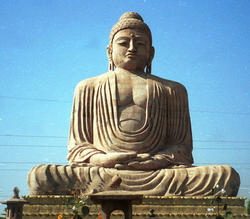 Hi, the second podcast for RPE (Religion, Philosophy & Ethics) 202 Buddhism is now available. This is a longer piece - so is hosted in a different location to the other podcasts for RPE.
This podcast is a reading (by me) of the Mahasatipatthana Sutta, on the Buddhist notion of the Four Noble Truths, with comments and explanations. While I will give a handout to you in class, the sutta is also at http://www.buddhanet.net/e-learning/mahasati.htm
The podcast download is at http://www.archive.org/details/DavidWebsterFourNobleTruthslecture/ or on the Higher Education section of iTunes.
As ever - do let me know if there are technical problems (it is a 27MB file, so you may need the patience of a Buddha...)
Dave
Sunday, February 18, 2007
EZ205 Langauge and Ethics podcast / Utilitarianism powerpoint
For those on EZ205 Language & Ethics, there is a short podcast with some definitions of Moral Realism at:
http://pebblepad.glos.ac.uk/blog.aspx?blogoid=5503 - hope it is useful. [It may be of interest to those studying A-level, ( As / A2) Religious Studies, Philosopy & Ethics - or for thier revision]
Those studying RPE103 Contemporary Ethical Issues may also want to have a listen. I have also added, at the same location, a copy of the Utilitarianism powerpoint that EZ205 and RPE103 students may find of use...
Cheers, Dave
[Oh - posts about the skills needed to study philosophy and/or ethics are still very welcome on the post below...]
http://pebblepad.glos.ac.uk/blog.aspx?blogoid=5503 - hope it is useful. [It may be of interest to those studying A-level, ( As / A2) Religious Studies, Philosopy & Ethics - or for thier revision]
Those studying RPE103 Contemporary Ethical Issues may also want to have a listen. I have also added, at the same location, a copy of the Utilitarianism powerpoint that EZ205 and RPE103 students may find of use...
Cheers, Dave
[Oh - posts about the skills needed to study philosophy and/or ethics are still very welcome on the post below...]
Wednesday, February 14, 2007
What skills do philosophy / ethics students need?
This post is to ask our students (and others) what skills they think are important in the study of Religion, Philosophy & Ethics. While it is initially for current students to reflect on what they did well/badly in the first semester - I, as ever, welcome contributions from our wider readership..
Dave
Dave
Tuesday, February 13, 2007
Ladies College Philosophy & Religion event

Last week, some of our staff and students attended an event at the Cheltenham Ladies College on Religion and Philosophy. This was mainly aimed at students of A-Level Religious studies (philosophy & ethics) - but they kindly had asked RPE students too.
Below is a report from two of the students who attended:
From Carol:
When we were given the opportunity to attend a Philosophy conference, three of us fellow students jumped at the chance. Not only did we think that the day would be philosophically interesting, we also wanted to have a 'peek' at the very famous Cheltenham Ladies College, where the conference was held. The building was very grand indeed. Although the conference
 was aimed at A-level students, it was a very intellectual discussion. In fact, we all feel that studying the 'Philosophy, Science and Belief' module (RPE 201) really helped us to gain a strong grounding in the discussions.
Keith Ward started the conference off by talking about the statement 'God is a delusion' and examined where our beliefs in God come from. He then opened the discussion to the students who asked many interesting questions. One young lady asked where our morals come from if we do not possess belief in God, Keith Ward very quickly replied that we cannot have a real morality if we do not believe in God, which of course we all disagreed very strongly with (as we feel we do possess morality!)
Anthony Flew was allotted to speak next, although he forgot that he had to be there and so he was late! (He is very old so we cannot hold him entirely responsible...) Keith Ward stepped in to talk about the Verification principle (he was a student of the very famous A. J Ayer!) and also spoke briefly on falsification. He was very impressive actually; he hadn't prepared but managed to speak very coherently on the subject.
During this time, some students attended an exam preparation workshop, which we did not attend (mainly due to the fact that we have just finished our exams!). Then it was time for a break - tea, coffee and biscuits were supplied! Yummy! Back to the Princess Hall again for another talk from Keith Ward examining the problem of evil, and attempting to explain why there is evil in the world today. From a Christian view, he attempted to explain evil due to our freedom in the world, and God could not intervene otherwise he would jeopardise our freedom. He also attempted to explain the notions of God's goodness and his omnipotence. Some 'smart alec' attempted to argue a very silly point - comparing God with Hitler - the room went incredibly silent by this remark!
Lunch time, and we went to a very cute little tea room.
When we arrived back, feeling very full, Anthony Flew had arrived! He looked very old and doddery, but also had a very warm charm to him. Flew and Ward had a debate concerning God's existence, but it was incredibly difficult to hear Flew, everyone had to strain their ears very hard. They both hated Darwin, and Flew became very animated indeed when he was arguing his point against Darwin. What we did find frustrating was that both Ward and Flew possessed belief in God, we would have liked to have seen an atheist there to stir things up a little!
Overall, it was a really enjoyable day!
From Shelley:
Anthony Flew apparently got the days muddled and didn't arrive until the afternoon. So Keith Ward delivered an unrehearsed and, well, an unwritten, talk on verification and falsification, which was impressive, but I still found him irritating. (By the way, without Philosophy and Science RPE201, I would have been lost for a lot of the day). When he talked about 'the problem with evil' he seemed to be saying that without God, there is no criteria for morality, goodness, friendship, all the virtues, really. So a young woman challenged him on it and he answered in a kind of wet way, and what I gathered from his response was that he didn't think morality, etc, was possible without God. Frankly, I didn't think he answered any of the questions well. He could lecture from his own position, but he didn't do well defending it. Also, he was always referring to striving towards the Good, as an objective reality that exists, God, Supreme Good, Ultimate Reality. And although, I couldn't formulate a question, I wasn't convinced by his argument (he also seemed like a dapper, chirpy-voiced, personable, cheerful, unangst-ridden little man which irritated me).
Frances, Emily and Carol asked very good questions.
 Anthony Flew hates Richard Dawkins. That came over loud and clear. But it was the only thing from him that did. He became very excited about 'time'. He was downright animated stating there hasn't been enough time for the natural selection process to have evolved to where we are today. But the problem with using ‘time’ to refute evolution theory and thereby using the refutation to support independent design theory, is fallacious reasoning of the bifurcation flavour. It’s the same as using irreducible complexities to slam evolution theory but simultaneously and indirectly using it to support independent design (as Carol pointed out in her question to Keith Ward – which he didn’t answer properly – where’s the little symbol on the keyboard that sticks its tongue out?). What I mean is the faulty reasoning is the either/or one, ‘if it’s not this, it’s that’. The ‘time’ evidence falsifies evolution theory. But that doesn’t necessarily lead to the acceptance or truth of independent design theory.
Keith Ward hates Richard Dawkins too. I think he used the word 'stupid' several times to describe RD. Unfortunately, I had to strain very hard to hear Anthony Flew. The afternoon session was organised like a conversation between KW and AF. So it was a little frustrating because AF couldn't be heard. Or Keith Ward would pontificate and Anthony Flew would nod his head and reply ‘Yes, yes’. He must be in his deep 80s and it was a great opportunity to see him, though.
Subscribe to:
Posts (Atom)