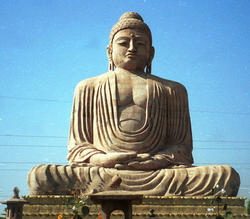
Hi, the Buddhism podcast 3 is now on-line.We offer an undergraduate degree in Religion, Philosophy & Ethics (RPE) , and an online MA in Philosophy & Religious Thought.
Sunday, February 25, 2007
Buddhism podcast 3
Hi, the Buddhism podcast 3 is now on-line.Wednesday, February 21, 2007
Group Discussions...
Buddhism Podcast 2: The Four Noble Truths
Hi, the second podcast for RPE (Religion, Philosophy & Ethics) 202 Buddhism is now available. This is a longer piece - so is hosted in a different location to the other podcasts for RPE.This podcast is a reading (by me) of the Mahasatipatthana Sutta, on the Buddhist notion of the Four Noble Truths, with comments and explanations. While I will give a handout to you in class, the sutta is also at http://www.buddhanet.net/e-learning/mahasati.htm
The podcast download is at http://www.archive.org/details/DavidWebsterFourNobleTruthslecture/ or on the Higher Education section of iTunes.
As ever - do let me know if there are technical problems (it is a 27MB file, so you may need the patience of a Buddha...)
Dave
Sunday, February 18, 2007
EZ205 Langauge and Ethics podcast / Utilitarianism powerpoint
http://pebblepad.glos.ac.uk/blog.aspx?blogoid=5503 - hope it is useful. [It may be of interest to those studying A-level, ( As / A2) Religious Studies, Philosopy & Ethics - or for thier revision]
Those studying RPE103 Contemporary Ethical Issues may also want to have a listen. I have also added, at the same location, a copy of the Utilitarianism powerpoint that EZ205 and RPE103 students may find of use...
Cheers, Dave
[Oh - posts about the skills needed to study philosophy and/or ethics are still very welcome on the post below...]
Wednesday, February 14, 2007
What skills do philosophy / ethics students need?
Dave
Tuesday, February 13, 2007
Ladies College Philosophy & Religion event

From Carol:
When we were given the opportunity to attend a Philosophy conference, three of us fellow students jumped at the chance. Not only did we think that the day would be philosophically interesting, we also wanted to have a 'peek' at the very famous Cheltenham Ladies College, where the conference was held. The building was very grand indeed. Although the conference
was aimed at A-level students, it was a very intellectual discussion. In fact, we all feel that studying the 'Philosophy, Science and Belief' module (RPE 201) really helped us to gain a strong grounding in the discussions.Keith Ward started the conference off by talking about the statement 'God is a delusion' and examined where our beliefs in God come from. He then opened the discussion to the students who asked many interesting questions. One young lady asked where our morals come from if we do not possess belief in God, Keith Ward very quickly replied that we cannot have a real morality if we do not believe in God, which of course we all disagreed very strongly with (as we feel we do possess morality!)
Anthony Flew was allotted to speak next, although he forgot that he had to be there and so he was late! (He is very old so we cannot hold him entirely responsible...) Keith Ward stepped in to talk about the Verification principle (he was a student of the very famous A. J Ayer!) and also spoke briefly on falsification. He was very impressive actually; he hadn't prepared but managed to speak very coherently on the subject.
During this time, some students attended an exam preparation workshop, which we did not attend (mainly due to the fact that we have just finished our exams!). Then it was time for a break - tea, coffee and biscuits were supplied! Yummy! Back to the Princess Hall again for another talk from Keith Ward examining the problem of evil, and attempting to explain why there is evil in the world today. From a Christian view, he attempted to explain evil due to our freedom in the world, and God could not intervene otherwise he would jeopardise our freedom. He also attempted to explain the notions of God's goodness and his omnipotence. Some 'smart alec' attempted to argue a very silly point - comparing God with Hitler - the room went incredibly silent by this remark!
Lunch time, and we went to a very cute little tea room.
When we arrived back, feeling very full, Anthony Flew had arrived! He looked very old and doddery, but also had a very warm charm to him. Flew and Ward had a debate concerning God's existence, but it was incredibly difficult to hear Flew, everyone had to strain their ears very hard. They both hated Darwin, and Flew became very animated indeed when he was arguing his point against Darwin. What we did find frustrating was that both Ward and Flew possessed belief in God, we would have liked to have seen an atheist there to stir things up a little!
Overall, it was a really enjoyable day!
From Shelley:
Anthony Flew apparently got the days muddled and didn't arrive until the afternoon. So Keith Ward delivered an unrehearsed and, well, an unwritten, talk on verification and falsification, which was impressive, but I still found him irritating. (By the way, without Philosophy and Science RPE201, I would have been lost for a lot of the day). When he talked about 'the problem with evil' he seemed to be saying that without God, there is no criteria for morality, goodness, friendship, all the virtues, really. So a young woman challenged him on it and he answered in a kind of wet way, and what I gathered from his response was that he didn't think morality, etc, was possible without God. Frankly, I didn't think he answered any of the questions well. He could lecture from his own position, but he didn't do well defending it. Also, he was always referring to striving towards the Good, as an objective reality that exists, God, Supreme Good, Ultimate Reality. And although, I couldn't formulate a question, I wasn't convinced by his argument (he also seemed like a dapper, chirpy-voiced, personable, cheerful, unangst-ridden little man which irritated me).
Frances, Emily and Carol asked very good questions.
Anthony Flew hates Richard Dawkins. That came over loud and clear. But it was the only thing from him that did. He became very excited about 'time'. He was downright animated stating there hasn't been enough time for the natural selection process to have evolved to where we are today. But the problem with using ‘time’ to refute evolution theory and thereby using the refutation to support independent design theory, is fallacious reasoning of the bifurcation flavour. It’s the same as using irreducible complexities to slam evolution theory but simultaneously and indirectly using it to support independent design (as Carol pointed out in her question to Keith Ward – which he didn’t answer properly – where’s the little symbol on the keyboard that sticks its tongue out?). What I mean is the faulty reasoning is the either/or one, ‘if it’s not this, it’s that’. The ‘time’ evidence falsifies evolution theory. But that doesn’t necessarily lead to the acceptance or truth of independent design theory.Keith Ward hates Richard Dawkins too. I think he used the word 'stupid' several times to describe RD. Unfortunately, I had to strain very hard to hear Anthony Flew. The afternoon session was organised like a conversation between KW and AF. So it was a little frustrating because AF couldn't be heard. Or Keith Ward would pontificate and Anthony Flew would nod his head and reply ‘Yes, yes’. He must be in his deep 80s and it was a great opportunity to see him, though.
Friday, February 09, 2007
Ethical Decisions - and the study of philosophy and ethics
But you can bet if I wake up and find a burglar in my home, the furthest thingHere is a point about how we decide - the process in the split-second moment - and whether we at that point apply any moral theory at all. Maybe we just act on instinct (that's what is sometimes feels like). OR perhaps we implicitly apply some set of crtieria? Or maybe it is habit/training?
from my mind will be the golden rule, however conceived or applied. And when I
call 911, it won’t be because I have reasoned that doing so will restore a
person’s soul to a state of virtue. More particularly, I won’t be doing that
type of reasoning while the burglar is in my home.
The second thing I thought about after reading this was: Does the study of ethics make you a better person?
[This is very pertinent in the UK, as many more people seem to be studying philosophy and ethics at A level
A-Levels (split into As/A2) are what UK students do between school and University - normally around the ages 16-18
AS and A2 Religious Studies now have a large portion of this type of material in them]
Anyway...
There could be numerous answers:
- Yes - I now think about others much more, and more concerned to act in an appropriate manner.
- No - but I am better at justifying my actions (actually driven by my lusts) to others as ethical.
- No - it has no impact.
- I still act the same - but tend to feel worse about it aftewards than I used to...
I am sure there are other answers - but wanted to ask readers: has the study of philosophy & religion (esp. ethics) changed you as a person?
DaveAnswers welcome from our Religion, Philosophy and Ethics students - and anyone else who has studied topics with an ethical/philosophical aspect: what did it do to you...
Tuesday, February 06, 2007
Podcast for Buddhism module
We should have the rest of these - as done - up on iTunes, so that they will be proper podcasts - anyway - comments on this first one are welcome...
[I am aware of the sound quality/volume issues - and hope to address these shortly]
D.
Monday, February 05, 2007
New Humanities course brochure
The new Departmental course brochure (for Humanities at the University of Gloucestershire - that is English Language; English Literature; Creative Writing; History and Religion, Philosophy & Ethics (RPE)) can now be downloaded at: http://www2.glos.ac.uk/offload/faculties/ehs/humanities/humanitiesBrochure.pdf
Friday, February 02, 2007
University of North Florida Philosophy Blog
[Image: University of North Florida]Thursday, February 01, 2007
RPE202 Buddhism
For those on the Buddhism module - you will shortly receive links to some introductory podcasts for this course. Till then - I would advise you to read the account of the Buddha's life as collected from the Pali texts - which is located at http://www.accesstoinsight.org/ptf/buddha.htmlWhen studying the life of the Buddha, what we have to keep in mind is that this is not so much an historical record of the life of the Buddha, as an account of what early Buddhism believed about the life of the Buddha.
Please ask questions about anything that puzzles you - either here on the blog, or via e-mail...
Dave
Sunday, January 21, 2007
Revision
I know, I know - exams are coming!
I had a request for extra info on contemporary Utilitarianism and other topics: here are some links to at least start you off (although we do have books in the library):
Intro to Utilitarianism
THIS ONE - may need you to be in the Uni - as it is a journal piece - but maybe not! Try it..
Also, as ever, the Stanford Encyclopedia of Philosophy is good: Try its piece on Consequentialism
If you need extra materials for the Hinduism course start at: http://uwacadweb.uwyo.edu/religionet/er/hinduism/index.htm
Good luck - and e-mail if you need any help! Dave
Tuesday, January 16, 2007
Islam in the Indian Subcontinent Conference
Thursday 19th April 2007
The Indian Subcontinent is a significant region for Islamic Studies,
having more Muslims than anywhere else in the world. Developments
in Islam in the region usually have a world-wide impact.
FCH Campus, Cheltenham, UK
---
Programme
10.30-11.00 Registration and Coffee, (Foyer, Clegg Building)
11.00 Welcome: Professor Patricia Broadfoot, Vice-Chancellor, University of Gloucestershire
11.05- 11.50 Rt Rev. Kenneth Cragg (Oxford): The Contemporary Significance of the Taj Mahal
11.50-12.35 Dr Mashuq Ibn Ally (Birmingham): Reform and revivalist movements in Pakistan and Bangladesh
12.35–1.35 LUNCH
1.35–2.20 Dr Theodore Gabriel (Gloucestershire): The Islamicisation of Pakistan
2.30–3.15 Dr Ian Williams (Central England): Ahmad Raza Khan [1856-1921]: Revivalism, Resistance, and Sunni – Shi’a relations in the sub-continent.
3.15–4.00 Dr David Immanuel Singh (Oxford): Centre and Margin - The Van Gujjar Muslim Tribals of Northern India and their relationship to mainstream Islam
4.00 Vote of Thanks: Dr Theodore Gabriel - Followed by Tea.
A sandwich lunch (to include sandwiches, crisps, cookies, fruit and coffee/tea) will be available if ordered when your booking is made. The cost for this is £5.00 and should be sent with your conference fee.
Speakers
Rt Rev. Kenneth Cragg:
Assistant Bishop of Oxford, Professor of Arabic and Islamic Studies, and author who has published prodigiously on the theme of Christian- Muslim relations. Author of The Call of the Minaret, Christ and the Faiths and Muhammad and the Christian among numerous other volumes.
Dr Mashuq Ibn Ally
Formerly Head of Islamic Studies at University of Wales, Lampeter, he is now Head of Equality and Diversity at Birmingham City Council. He is the author of Theology of Islamic Liberation, Religious Experience and Islam;, Law, blasphemy and the multi-faith society, and the section on Islam in Ethical Issues in Six Religions.
Dr Theodore Gabriel
Formerly a Senior Lecturer in Theology and Religious Studies at the University of Gloucestershire he is now Honorary Research Fellow in the Department of Humanities at the same institution. He is the author of Christian-Muslim Relations (1996), Hindu and Muslim Inter-Religious Relations in Malaysia (2000), editor of Islam in the Contemporary World (2000) and co-editor of Islam and the West Post – September 11t h (2004)
Dr Ian Williams
Senior Lecturer and Subject Leader of Religious Education at the University of Central England. His recent publications include: An Absent Influence? The Nurcu/Fetullah Gulen Movements in Turkish Islam and their potential influence upon European Islam and global education, and Relics and Reliquaries: Signs and Semiotics in contemporary UK Islam
Dr David Immanuel Singh
Research Tutor in South Asian Studies, Admissions Tutor and MPhil Programme Leader at the Oxford Centre for Mission Studies. His recent publications include: Sainthood and Revelatory Discourse: An Examination of the Bases for Bayan’s Authority in Mahdawi Islam, and Physical Jihad: Current Perspectives on Islamic ‘Holy War’.
FEES: £16 (£8 for students and the unwaged; £5.00 for students of University of Gloucestershire). Tea/Coffee will be served morning and afternoon.
Enquiries
Telephone: 01242 714570 Fax: 01242 714826
Email: pdownes@glos.ac.uk
Monday, January 15, 2007
Friendship, Philosophy & January...
[I changed the picture, as the old one was a bit sickly.... - or so some visitors thought...]He gives what is beautiful,
hard to give,
does what is hard to do,
endures painful, ill-spoken words.
His secrets he tells you,
your secrets he keeps.
When misfortunes strike,
he doesn't abandon you;
when you're down & out,
doesn't look down on you.
A person in whom these traits are found,
is a friend to be cultivated
by anyone wanting a friend.
Wednesday, January 10, 2007
Gay Rights, Faith and the Law
A number of faith groups had objected to the regulations. The rules mean that people who offer paid services to the public cannot refuse people, or discriminate against them, on the grounds of their sexuality.
To quote the BBC report on this:
Critics say the new rules mean hotels cannot refuse to provide rooms for gay couples, and religious groups would be obliged to rent out halls for "gay wedding" receptions.
Is this - as some have reported - about gay rights vs 'Christian' rights? Clearly not all Christians feel this way - but the quote below shows how some feel...
Christian Voice - a pressure group - claims in its press release that:
'The Government and their 'gay rights' friends have no right to impose their morality, or lack of it, on the 99% of the population who are not that way inclined. Christians, members of other faiths and indeed of none cannot be forced to act against their conscience by providing services to those whose activities they find perverted, disgusting or simply against the clear, unequivocal word of God."
Gay Rights Campaigner Peter Tatchell said of faith campaigns against the regulations:
"The Christian fundamentalists who want these exemptions are demanding the right to discriminate against gay people, but they are not campaigning for the right to discriminate against adulterers, unwed mothers, thieves, murderers or rapists. They have a highly selective and overtly homophobic interpretation of Biblical morality."
Should people be 'forced' to offer services to all - or have the right to decline in the manner some seem to wish to?
Is this about rights at all?