Showing posts with label RPE. Show all posts

Wednesday, April 06, 2016

Is Evil really Good or is Good really Evil? How DreamWorks tackles this issue in Megamind - by Alex Griffiths

Animation:  Is this a modern medium of philosophical thought? Within Plato’s Symposium, Apollodorus expresses that philosophy is the only enjoyable subject; is this so the case, that even within children’s entertainment there is this requirement for philosophy to encroach?
Children’s film and literature (I’m sure most mediums) are filled with extremely powerful messages and moral guidelines. The lists are endless from Dr Seuss raising questions about the theory and nature of knowledge to Jacqueline Wilson embedding deep moral issues and guidance. Even big friendly authors such as Roald Dahl are at it!  But to return to film, DreamWorks, Pixar and Disney all fill their movies with powerful thoughts; Look at Wall-e as an example, a robot who’s function it is to clean up the planet due to human consumption providing huge topical environmental issues regarding the destruction we are causing to this planet, thus allowing insight to the instability and the fragility of our world. Not to mention the connection and empathy that is created within the robot, leading to such questions as what is it to be human and what sets this robot apart from humankind.
These large film industries are providing deep philosophical questions to become digested, disguised under comical scripts and loveable characters. Entertainment aimed at children provides vital education. This returns me to Apollodorus’ immense delight in philosophic discourse and his belief that other sorts of talk, especially that of wealth and "money-bag friends", not only annoys him but creates a sense of sorrow within him because others believe that this type of talk is of value.[1] I have to agree with him, and so does the entertainment industry. Within morality, a base guideline can be seen throughout history. Look at religious texts as a whole.  Does it not provide guidelines to a prosperous way of life - if not in this one, then in ones to follow? To tie this together, evidence of this thirst for moral codes can be seen throughout all children’s literature over the years from Grimms' nursery tales to Aesop’s fables.  This thirst provides evidence that morality is needed within society and human nature as we always are striving towards it. Without it the world would become pure anarchy, and society as we know it will break down, thus the importance of teaching children basic principles from a young age is important.
As titled, this is a review of Megamind, so I will look into the philosophical nature of the film, thus contextualising the idea that the industry provides deep thought and insight into what could be argued as higher thought into a relatable medium. So let’s start with the beginning…the very beginning:
The opening scene is of two planets at the brink of destruction, when baby Megamind and MetroMan are seen flying to earth. MetroMan begins his life in luxury and Megamind finds himself in prison. The two main characters grow up together, yet despite MegaMind’s efforts to fit in, he only gets more secluded, until he ‘learned a very hard lesson: good receives all the praise and adulation while evil is sent to quiet time in the corner. So fitting in wasn't really an option.[2]
The comical nature of the film allows for the depth to be the underbelly of the scene. What is, on first glance, portraying comedy and a base for the story line, actually in fact is asking and providing a springboard to deep abstract thought. The above quote is part of the opening spiel and provides an introduction of the two leading roles of the film. But what is so powerful is that it is playing on the notion of destiny. It sets forward the question of whether we can choose the lives that we lead, and if this choice can be changed or whether such matters are predestined. The film continues to look upon this paradigm of destiny, yet always relates it to the juxtaposition of good and evil. Other issues are raised within the film, such as the notion of what happens to the balance when evil beats good. Megamind (Will Ferrell) in this instance becomes bored. Could we take this notion to a present reality away from the abstract of animation as a thought process; what would it be like if good conquered evil? Looking briefly at Christianity, with heaven described as a place of eternal bliss and happiness, void of evil, would this be as Megamind describes…boring? Another issue that I find problematic when trying to identify what is evil, is that if there is no such thing as evil than surely there can be no concept of good. Existence would just become existence and therefore extremely mundane with potentially no purpose. Megamind brings light to this issue by showing that from the super hero to the super villain there is a mixture of characteristics showing that no one is wholly good or evil.
The notion of good and evil that I find particularly problematic is defining what it actually means to be evil. If arguing it is people’s actions, surely this is subjective; not only just within opinion yet also culture and time have a great impact. Throughout the film, Metro Man (Brad Pitt) plays the super ‘hero’.  Within the eyes of the citizens, he is a treasure; the man of the city.  But when looking through the introduction of the film and watching the two characters grow up together, he can be seen to be supressing Megamind and forcing him to become evil. Can it not be interpreted that Megamind was just trying to gain the same respect that the arrogant Metro Man was receiving.  Therefore could it not be that through Metro Man’s actions of always trying to one up and revel in his own glory that he forced Megamind to become evil? So even from the onset of the film it provides insight that ‘good’ has the capacity to create evil. The playing on the ideas of good and evil throughout the film show the lack of clarity and contrast defining what it is to be good. It shows that perhaps one cannot just be evil, only certain actions or perhaps characteristics can be. There is a real emphasis on the problematic idea of labelling something either way. 

Alex Griffiths is a second-year History and RPE student. He has his own blog at: https://alexlgriffiths.wordpress.com




[1] Plato. Plato in Twelve Volumes, Symposium 173c, Vol. 9 translated by Harold N. Fowler. Cambridge, MA, Harvard University Press; London, William Heinemann Ltd. 1925
[2] Megamind, dir. Tom McGrath, DreamWorks, 2010

Friday, September 18, 2015

Welcome to all the New Students

Welcome to all our new students who are starting the great adventure that is known as RPE. As Dave mentioned in the previous post, we did excellently in the NSS again. This is testimony not only to us, but also to our wonderful students.

There are many great ideas and activities you are going to be introduced to throughout the year, but one that thing that makes RPE special is all the extra stuff we get up to: visits, societies, and clubs. Oh and we also have been known to go to the pub once and a while.

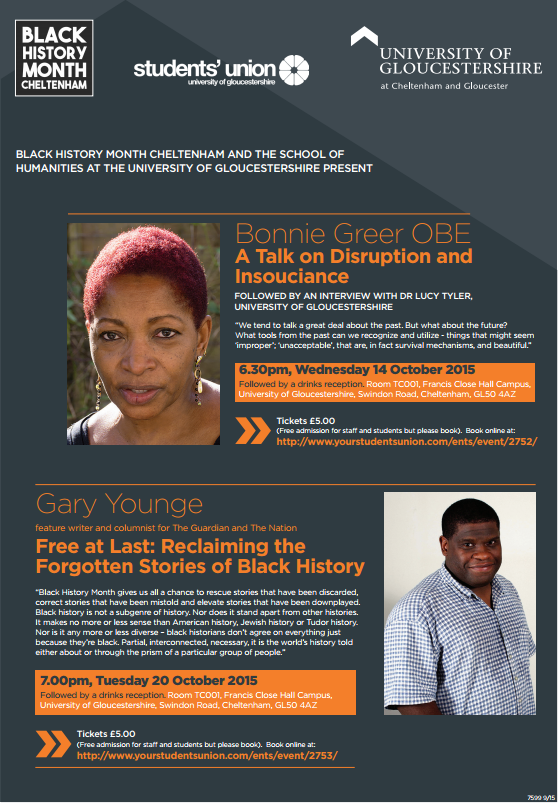
One important event that I do want to direct your attention to, which is happening soon and is organised by our friends in history, is Black History Month. There will be two events at FCH, which you might be interested in.

Bonnie Greer 'A Talk on Disruption and Insouciance'
Wednesday 14th October, 6.30-8.00 pm

Gary Younge 'Free at Last: Reclaiming the Lost Stories of Black History'
Tuesday 20th October, 6.30-8.00 pm

Both are at FCH and in TC001.

You can book both events at the SU website

Thursday, May 15, 2014

Open Days this Summer..

These events have now taken place - but to find out about our other, upcoming, Open Days, see: 

---

As Summer approaches, we look forward to welcoming Religion, Philosophy & Ethics applicants / guests to Open Days here at our FCH Campus in Cheltenham. There will be events on June 25th and June 28th (and more in September and October).

You can find out more, and book a place by going to:  http://www.glos.ac.uk/open/Pages/undergraduate.aspx 

In addition to Open Days, you can discover more about the Religion, Philosophy & Ethics undergraduate BA(Hons) degree over at our Facebook Group:

FCH Campus
To see the course map - details of the 'modules' which form the course - click HERE, or to see our Photo Gallery of trips, events and the campus, click HERE.

The tabs at the top of this page also allow you to explore the course via Twitter, find out who we are, and see video materials on topics related to the course.

Saturday, November 05, 2011

New visitors

I have just come back from an Open Day here in Cheltenham, talking to people about the RPE course...

I thought I'd pop a post here in case any of them/you are looking for more info...

The blog archives are a good start - including ones about our field trip, and our 'worst argument' competition... - just browse and see what is there.

Also - see the course Facebook group at: http://www.facebook.com/groups/RPEglos/ - you don't have to join to look at info here, but anyone with an interest is welcome to join - and feel free to post questions and chat with our current and past students.

http://www.visitcheltenham.com/ can give you more info about the town, and http://www.cheltenhamfestivals.com/ has loads of info re Cheltenham International Literature Festival, and the others festivals that the town hosts  - more about this HERE..

 Of course - you can always get in touch via email: dwebster@glos.ac.uk and ask us questions...
Cheers,
Dave

Thursday, December 09, 2010

Facebook

http://bit.ly/rpeglos is the address for a new Religion, Philosophy and Ethics at Gloucestershire facebook group - all are welcome to join...


d.

Thursday, October 21, 2010

RPE208 Day-Trip to Oxford


For students on the Indian Religions module:

The plan...

We go to the Ashmolean Museum in Oxford ( http://www.ashmolean.org/ ) on Friday November 5th.

We will meet on the museum steps, at 12:45.

You can get the bus from Cheltenham – the Swanbrook 853 Service leaves at 11am from Chelt (Royal Wells Bus Station) and gets in around 12.30.

It leaves Oxford to return at 6pm (the Museum shuts at 6 anyway) - from St Giles (Taylorian Institute) - where it drops off on the way in.... (near Ashmolean) Back to Chelt 7:35pm.

details: http://www.swanbrook.co.uk/busServicesOxford

A day return costs £10. The museum is free.

A couple of hours in the museum should leave you with time to explore Oxford / shop / eat...


You can of course drive – but I would advise using the park and ride – as Oxford seems to have no public parking left...

Students not on this module can come, but need to let me know..

Cheers,
Dave

Friday, October 08, 2010

Studying Religion, Philosophy & Ethics at University

This Saturday sees one of our biggest Open Days (info: here), and I will be doing my bit, talking about what it is like to study religious, philosophical and ethical ideas, especially on our course here at University of Gloucestershire...

In discussing what I was planing to say, with a colleague, I was saying that I always get a what's the point? question: often framed in terms of what type of job a degree like this might lead graduates toward, but also - on occasion - in more general terms.. (His response, by the way, was the surely that a student who had studied philosophy, in particular, could do anything - I liked that answer...)

But it got me thinking...

Of course, on one level, I think "what's the point of studying anything else?" - the things we cover seem so vital, so central to what it means to be a human being, that the question is hard to get one's head round...

But: not everyone feels quite the same as we do about the topic - so beyond the intrinsic value of studying RPE, what does it give students? Of course, it gives them lots of analytical and critical skills, the ability to appreciate complex ideas, to deal with conceptually difficult material, to explain exactly what they mean, and to understand and articulate a range of religious notions. It provides them with the confidence to robustly defend points of view, verbally, or in written form, and the ability to revise their points of view as they see fit.

But, and I think this is very much true when I look at, and talk to, our graduates, it seems to make them thoughtful, especially when it comes to matters that impact on other people. By which, I think what I will say at the Open Day tomorrow is that we really strive, in a way that many other disciplines perhaps do not, to make our students better people.
This may seem odd, and we certainly don't tell them what to think (not that they'd listen - they often are rather argumentative and independent-minded [which is a good thing]) - but we do tell them that it is their duty to think; and that the ideas on the course will challenge them to produce an ethical response...


Sunday, September 19, 2010

Welcome!

So - another year...

A big welcome back to all existing RPE students, and an equally excessive welcome to all our new Religion, Philosophy & Ethics students. We will be seeing you all week - but do browse these blog archives to get more of a sense of the course.

The presentation below gives details about the opportunities for travel, that I mentioned during the main Humanities Induction talk... (press the 'play' button > )

contact me on dwebster@glos.ac.uk for more details...
Cheers,
Dave

Wednesday, September 01, 2010

Flickr updates

Just a quick note: have finally begun to add some stuff to the RPE Flickr page (see widget to the right) - or http://www.flickr.com/photos/58244916@N00/ - hope to add some more soon...

Tuesday, September 15, 2009

Ning?

This is a post just for our current RPE / Philosophy students: we have a social network (with chat, forums, etc) for the course at http://rpeglos.ning.com/ - all level 2 and 3 students should have had an invite to join by now - and level 1 students (who are still in he process of registering this week) will get an invite soon...

If I have missed anyone - just email me from your glos account and I'll add you...
Cheers,
Dave

Wednesday, July 22, 2009

Swings and Roundabouts...

Some changes to let people know about this summer...

Some minor changes to the RPE Course have taken place, and we have also launched a straight Philosophy programme as well.

The role of Course Leader has passed from myself to Dr Roy Jackson - who now takes on the role - and good luck to him with all those annual reports, programme change committees and student questions...

In addition to that - we have a new member of staff as well. Dr William Large has joined us and will be teaching from Spetember. I expect Will to introducue himself on here soon, but if you can't wait his profile at his previous job is still live HERE - but probably not for long...

Wednesday, January 09, 2008

Why Study Religion, Philosophy and Ethics?

Philosophy seems more popular in Schools than ever. [As noted HERE by Nigel Warburton]

In Scotland, the Herald newspaper has considered this - causing a number of its online readers to comment HERE about the value of philosophy. The comments are worth a glance as they reveal something of the public attitude to philosophy.

I wanted to ask our students (and other readers) to comment as to:
  • Whether there was any value in studying philosophy (to both individuals and society in general)
  • Whether academic disciplines such as Philosophy and Religious Studies should have to demonstrate a 'usefulness' in order to be considered worthwhile
  • What reasons motivate individuals to study these subjects. [See HERE for previous posts on this topic]
  • Why has there been such a rise in the numbers studying Religious Studies and Philosophy (often including ethics) at AS/A2 ('A' level to older people like me) here in the UK?

Sunday, September 16, 2007

Welcome!

Just a quick post to welcome the new intake of Religion, Philosophy & Ethics students - who we meet tomorrow...

On behalf of myself, Dee, Alison, Roy, Melissa and Nigel (and the others you will have from time to time) - we hope all goes well in Induction week - and that students from years 2 and 3 will join in welcoming you...

Dave

Friday, September 14, 2007

RPE 307

For those of you keen to make a start on Beyond Good and Evil (and why shouldn't you be!) we will be using the translation by Marion Faber, published by Oxford University Press. Translations do vary quite a bit so it's best we all follow the same one. In terms of commentaries, take your choice from either Laurence Lampert or Douglas Burnham, or both if you're feeling particularly flush at the moment! Looking forward to it and remember that the text is open to interpretation and it's your understanding of it that I'm particularly interested in!

For Nietzsche 'Fans'


Check out the Nietzsche Circle. Their 'vision statement' is: 'To create an intellectual and artistic community whereby individuals of similar spirit and vision may come together and explore Nietzsche’s philosophy, developing ways in which it can be transfigured.' It's good particularly for book reviews and essays on Nietzsche. Also, Brian Leiter (who has written an excellent book on Nietzsche's moral philosophy) has started up a new Nietzsche blog.

Thursday, July 05, 2007

Religion, Philosophy & Ethics (RPE) Staffing Update...

Well, after a very demanding and competitive process (we were hugely impressed by both the quantity of applicants, and the very high quality of them) of selecting a new member of staff to join us on the RPE team, we can announce the result. From next Semester, we will be joined by Dr Roy A Jackson. We are very excited about this - and I have asked him for a paragraph to introduce himself - which is below. I also managed to persuade him to let me have a photo of him. I am sure students will join the staff in making him feel welcome.
Dave


I was born in Liverpool and did my doctorate at the University of Kent where I also lectured for a number of years. I have, in my time, taught in secondary schools, colleges and various universities including Durham and King’s College London. I specialise in Nietzsche, Philosophy of Religion, and Islamic Philosophy and recently published two books for Routledge: Nietzsche and Islam, and Fifty Key Figures in Islam. I’m really excited at the prospect of teaching in the RPE department and, of course, experiencing the ups and down of the Robins (Cheltenham Town FC!).

Thursday, June 07, 2007

Religion, Philosophy & Ethics (RPE) Summer Meal


Thanks to the Student Reps who have organised this. Following the success of the RPE Xmas meal, we are now having an event on Wednesday 13th Jun 2007 at 6pm. It will be at the Cheltenham Tandoori (details below).

If you want to come, and have not told Shajaat (or your student rep) - I can pass on a message - so we have an idea of numbers...

See you there - - Dave

Tuesday, February 13, 2007

Ladies College Philosophy & Religion event


Last week, some of our staff and students attended an event at the Cheltenham Ladies College on Religion and Philosophy. This was mainly aimed at students of A-Level Religious studies (philosophy & ethics) - but they kindly had asked RPE students too.

Below is a report from two of the students who attended:

From Carol:

When we were given the opportunity to attend a Philosophy conference, three of us fellow students jumped at the chance. Not only did we think that the day would be philosophically interesting, we also wanted to have a 'peek' at the very famous Cheltenham Ladies College, where the conference was held. The building was very grand indeed. Although the conference was aimed at A-level students, it was a very intellectual discussion. In fact, we all feel that studying the 'Philosophy, Science and Belief' module (RPE 201) really helped us to gain a strong grounding in the discussions.

Keith Ward started the conference off by talking about the statement 'God is a delusion' and examined where our beliefs in God come from. He then opened the discussion to the students who asked many interesting questions. One young lady asked where our morals come from if we do not possess belief in God, Keith Ward very quickly replied that we cannot have a real morality if we do not believe in God, which of course we all disagreed very strongly with (as we feel we do possess morality!)

Anthony Flew was allotted to speak next, although he forgot that he had to be there and so he was late! (He is very old so we cannot hold him entirely responsible...) Keith Ward stepped in to talk about the Verification principle (he was a student of the very famous A. J Ayer!) and also spoke briefly on falsification. He was very impressive actually; he hadn't prepared but managed to speak very coherently on the subject.

During this time, some students attended an exam preparation workshop, which we did not attend (mainly due to the fact that we have just finished our exams!). Then it was time for a break - tea, coffee and biscuits were supplied! Yummy! Back to the Princess Hall again for another talk from Keith Ward examining the problem of evil, and attempting to explain why there is evil in the world today. From a Christian view, he attempted to explain evil due to our freedom in the world, and God could not intervene otherwise he would jeopardise our freedom. He also attempted to explain the notions of God's goodness and his omnipotence. Some 'smart alec' attempted to argue a very silly point - comparing God with Hitler - the room went incredibly silent by this remark!

Lunch time, and we went to a very cute little tea room.

When we arrived back, feeling very full, Anthony Flew had arrived! He looked very old and doddery, but also had a very warm charm to him. Flew and Ward had a debate concerning God's existence, but it was incredibly difficult to hear Flew, everyone had to strain their ears very hard. They both hated Darwin, and Flew became very animated indeed when he was arguing his point against Darwin. What we did find frustrating was that both Ward and Flew possessed belief in God, we would have liked to have seen an atheist there to stir things up a little!

Overall, it was a really enjoyable day!

From Shelley:

Anthony Flew apparently got the days muddled and didn't arrive until the afternoon. So Keith Ward delivered an unrehearsed and, well, an unwritten, talk on verification and falsification, which was impressive, but I still found him irritating. (By the way, without Philosophy and Science RPE201, I would have been lost for a lot of the day). When he talked about 'the problem with evil' he seemed to be saying that without God, there is no criteria for morality, goodness, friendship, all the virtues, really. So a young woman challenged him on it and he answered in a kind of wet way, and what I gathered from his response was that he didn't think morality, etc, was possible without God. Frankly, I didn't think he answered any of the questions well. He could lecture from his own position, but he didn't do well defending it. Also, he was always referring to striving towards the Good, as an objective reality that exists, God, Supreme Good, Ultimate Reality. And although, I couldn't formulate a question, I wasn't convinced by his argument (he also seemed like a dapper, chirpy-voiced, personable, cheerful, unangst-ridden little man which irritated me).

Frances, Emily and Carol asked very good questions.

Anthony Flew hates Richard Dawkins. That came over loud and clear. But it was the only thing from him that did. He became very excited about 'time'. He was downright animated stating there hasn't been enough time for the natural selection process to have evolved to where we are today. But the problem with using ‘time’ to refute evolution theory and thereby using the refutation to support independent design theory, is fallacious reasoning of the bifurcation flavour. It’s the same as using irreducible complexities to slam evolution theory but simultaneously and indirectly using it to support independent design (as Carol pointed out in her question to Keith Ward – which he didn’t answer properly – where’s the little symbol on the keyboard that sticks its tongue out?). What I mean is the faulty reasoning is the either/or one, ‘if it’s not this, it’s that’. The ‘time’ evidence falsifies evolution theory. But that doesn’t necessarily lead to the acceptance or truth of independent design theory.

Keith Ward hates Richard Dawkins too. I think he used the word 'stupid' several times to describe RD. Unfortunately, I had to strain very hard to hear Anthony Flew. The afternoon session was organised like a conversation between KW and AF. So it was a little frustrating because AF couldn't be heard. Or Keith Ward would pontificate and Anthony Flew would nod his head and reply ‘Yes, yes’. He must be in his deep 80s and it was a great opportunity to see him, though.